Nylas vs Resend: Which Email API Fits an AI Agent?

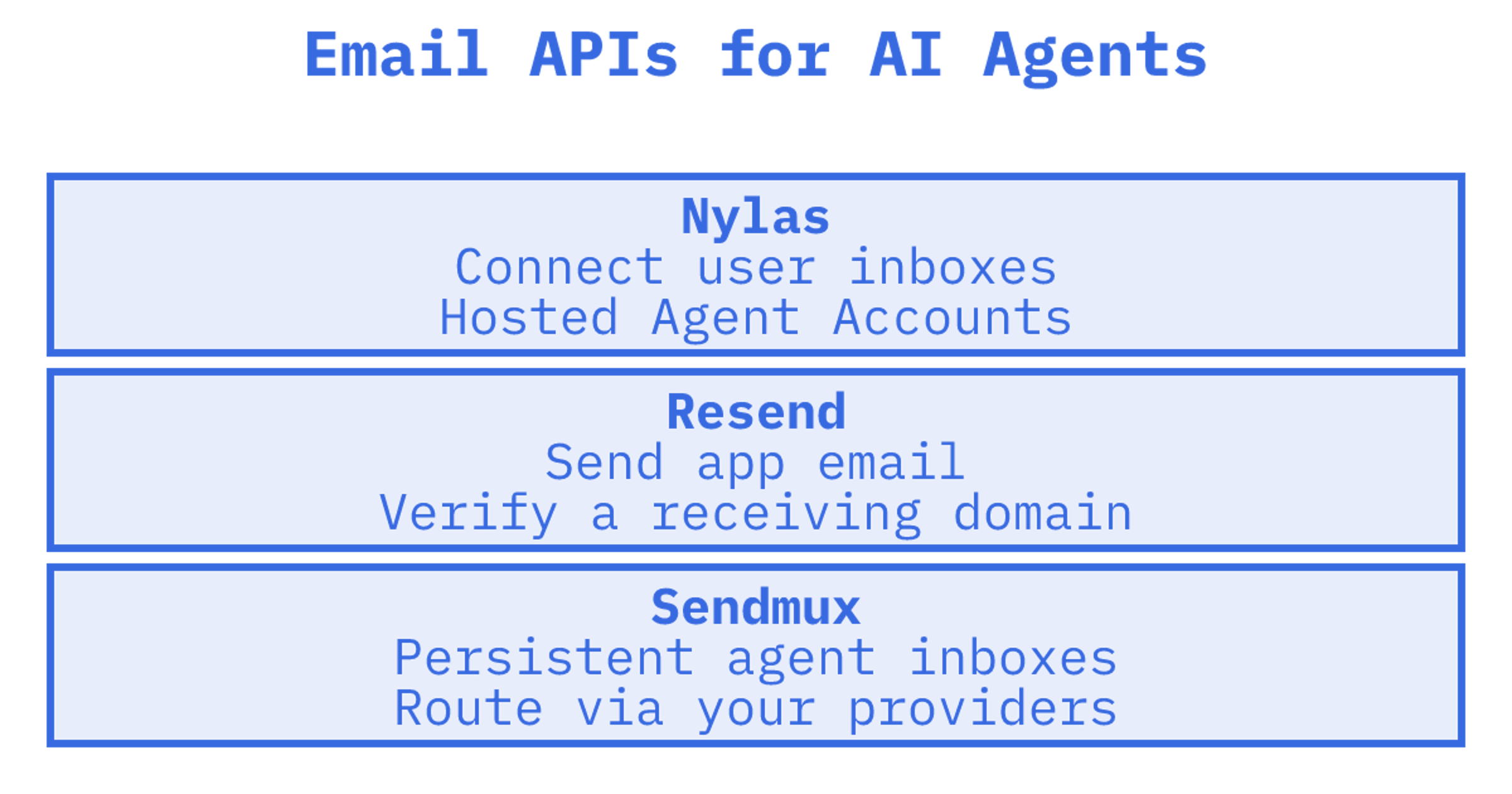
Nylas and Resend solve different problems. Nylas is built around connecting to the mailboxes and calendars your users already own, and has recently added hosted agent identities. Resend is built around sending your own app's email cleanly, with receiving and per-agent inboxes added more recently. If your agent needs a real, persistent mailbox and your outbound traffic must run across several providers, a third option, Qubrics, covers both halves in one API. This guide compares the three on the criteria that matter in production.
TL;DR
- Nylas suits products that read and write inside end users' existing Gmail or Outlook accounts, and now offers Agent Accounts for agent-owned identities.
- Resend suits product teams that already send app email through it and want agents in the same account, with inbound handled through a verified domain.
- Their pricing logic differs: Nylas has historically been priced on connected accounts and API volume, while Resend is priced around email volume and plan quota.
- Qubrics lets you create a persistent mailbox for each agent or tenant, subject to plan limits. For outbound, it routes through connected Gmail OAuth, Outlook and custom SMTP accounts, with fees from US$0.000500 per provider-accepted recipient.
Table of Contents
What Nylas and Resend are each built to do
The two names get compared because both appear when a developer searches for "email API". They sit at different layers.
Nylas is a unified API over other people's mailboxes and calendars. You connect an account through OAuth, then read, send and organise messages through one interface instead of writing separate Gmail and Microsoft Graph integrations. The company says its platform is used by over 100,000 developers. In June 2026 it announced Agent Accounts, which per the launch coverage give AI agents Nylas-hosted email addresses and calendars through the existing v3 endpoints, with sending, receiving and full reply threads.
Resend is a developer-first sending API. Its pull is a clean API and good developer experience for transactional and product email: password resets, receipts, notifications. It has since moved towards receiving. According to one 2026 roundup, Resend Inboxes added per-agent addresses with threaded messages and one-call replies, though inbound email counts toward the plan quota and needs a verified domain with receiving switched on.
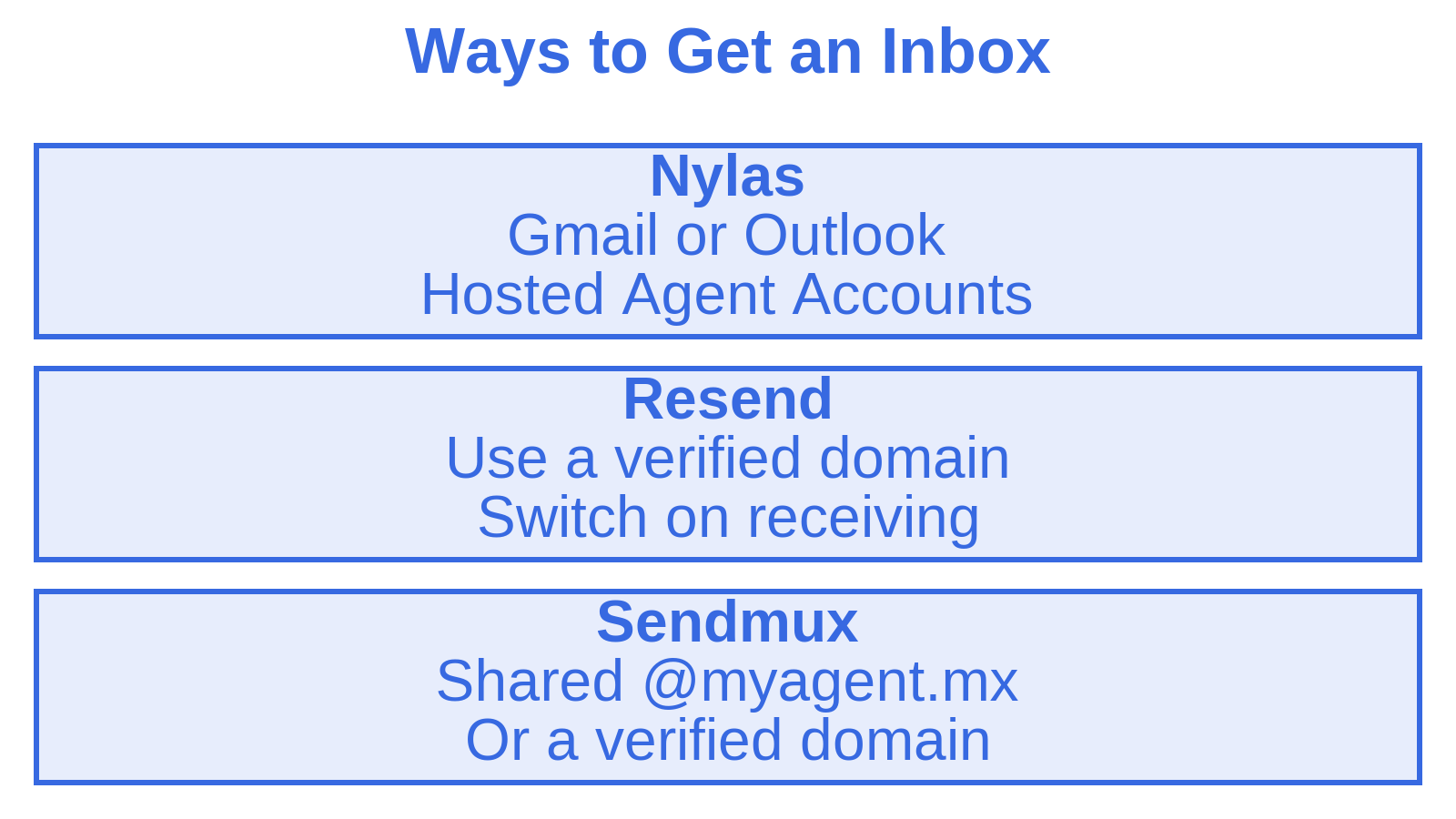
Put simply: Nylas started from the mailbox and works outward to agents. Resend started from the send call and is working inward to the mailbox.
Side-by-side comparison
| Criterion | Nylas | Resend | Qubrics |
|---|---|---|---|
| Origin | Unified access to users' existing mailboxes and calendars | Developer-friendly sending API for app email | Email API for AI agents: mailboxes plus multi-provider sending |
| Agent-owned mailbox | Agent Accounts (announced June 2026) | Inboxes (per-agent addresses, added October 2026) | Persistent mailboxes for agents, customers, workspaces or tenants, subject to plan limits |
| Mailbox address | Nylas-hosted identity | Address on your verified domain with receiving on | Included @myagent.mx domain, or a custom domain verified for receiving |
| Outbound across your own providers | Not its core model | Sends through Resend | Routing through connected Gmail OAuth, Outlook and custom SMTP accounts. Managed Amazon SES is a separate route. |
| Pricing logic | Connected accounts and API volume | Email volume and plan quota | Per recipient sent, per mailbox delivery and per GB stored |
| Best fit | Products acting inside end users' inboxes | Teams whose app email already lives in Resend | Agent products needing mailboxes, routing and provider control in one place |
Sending and receiving: replies, threads and webhooks
For an agent, the send call is the easy part. The hard parts are what happens after: a customer replies, the reply must land in the right thread, the agent must read only the new text, and something must tell the agent it arrived.
Threads and replies
Nylas Agent Accounts are reported to support full reply threads, which matters because the platform already has years of thread handling for connected accounts. Resend Inboxes are reported to offer threaded messages and one-call replies. In both cases, verify how quoted history is handled before you rely on it: an agent that re-reads the entire quoted chain on every turn wastes tokens and can act on stale instructions.
Qubrics strips quoted history by default in its clean content endpoint. The agent can read the new reply as text or request cleaned HTML without parsing a raw MIME thread. Use the raw body endpoint to read the message body as available from the mailbox. We cover the checks worth running on any provider in 8 email threads API checks before agents go live.
Inbound retrieval and change detection
An agent should not re-list an inbox to find what changed. Qubrics's Mailbox API filters messages by folder, thread, free text, sender, recipient, subject, body, headers, size, keywords, date range, attachments and unread status. A count endpoint answers "how many" without returning rows, search-snippets return previews without bodies, and sync endpoints return state tokens so the agent polls for typed changes only. Batch get, update and delete move many messages in one call.
Whatever you choose, ask each vendor the same three questions: how does the agent learn a message arrived (webhook, event stream or polling), how are duplicates and retries handled, and what happens to messages that arrive while your endpoint is down.
Setup, SDKs and multi-tenant fit
The setup burden differs by model.
- Nylas connected accounts require an OAuth consent flow per user, which is the right shape when your product acts for a person inside their own inbox. Agent Accounts remove that step for agent identities by hosting the mailbox for you.
- Resend requires a verified domain with receiving turned on before inbox email works, so you handle DNS first. That is fine for one company domain, and more work when every tenant brings its own.
- Qubrics includes the @myagent.mx domain so an agent can have a working address immediately, and supports custom domains verified for receiving. An agent can register a shared-domain inbox without any DNS setup. It can use REST or the CLI to register. Server-Sent Events are available for agents, CLIs, MCP servers and SDKs that need live mailbox updates.
For multi-tenant products, the questions are isolation and attribution. Can each tenant have its own address, keys and logs? Can you cap one tenant's volume without touching the others? Qubrics supports configurable provider quotas, team-owned delivery groups, mailbox-scoped credentials and delivery logs.
If your agent lives in a client such as Claude or Cursor, an MCP server makes tool access simpler. Agents in that setup often reach other services the same way, for example through an MCP integration with AI agents for supplier checks, so a mailbox exposed over MCP slots into the same pattern. See Qubrics for AI agent builders.
What each one costs
Pricing is where the three differ most, and where surprises appear.
Nylas. Pricing has been structured around API call volume, the number of connected accounts and the feature tier. Vendr's marketplace data reports a median buyer paying US$30,600 per year across 33 purchases, with a range from about US$4,956 to US$150,305. Those are negotiated contracts for typical products, so treat them as a sense of scale and get a current quote for Agent Accounts specifically.
Resend. Pricing is tied to email volume under a plan quota, and because inbox email counts toward that quota, an agent that receives a lot of mail consumes the same allowance as your outbound. Check Resend's own pricing page for current tiers before you model it.
Qubrics. Published pricing, in US dollars:
| Item | Price |
|---|---|
| Free plan | US$0 per month per team |
| Pro plan | US$7 per month per team |
| Enterprise | No published price |
| Connected outbound | US$0.000500 per provider-accepted recipient |
| Managed sending | US$0.000750 per provider-accepted recipient |
| Inbound | US$0.000500 per distinct mailbox delivery |
| Storage | US$0.02 per month per GB |
Connected outbound is for sending through providers you bring, such as your own Gmail, Outlook or custom SMTP accounts. Managed sending uses the Amazon SES account supplied by Qubrics. Qubrics avoids per-inbox pricing on non-enterprise plans, so adding mailboxes is not billed per mailbox. A worked example: 100,000 recipients accepted through your own providers cost US$50.00 in connected outbound fees (100,000 × US$0.000500), before any plan or storage charge. See the full pricing page for the current terms.
Reliability, security and what to verify
Nylas Agent Accounts are reported to carry Nylas's compliance posture, including SOC 2 Type II, HIPAA, ISO 27001, ISO 27701, GDPR and CCPA, according to the launch coverage. If you sell into regulated industries, that is a real point in Nylas's favour, and you should confirm the scope with the vendor in writing.
Whichever you pick, a short pre-production list saves pain:
- Quota behaviour. What happens at the limit: throttle, queue or reject?
- Provider failure. If the sending provider rate-limits or suspends an account, does mail fail over automatically?
- Authentication. SPF, DKIM and DMARC for every sending domain, not just the first.
- Logs and suppressions. Can you see bounces and delivery per tenant?
- Token health. If you depend on user OAuth tokens, plan for expiry and re-consent in production.
For the sending side in general, our developer guide to sending email via API walks through the basics.
Which one should you choose?
- Choose Nylas when your product must work inside end users' own Gmail or Outlook accounts, or when enterprise compliance paperwork leads the decision.
- Choose Resend when your app email is already there and you want a few agent addresses on one verified company domain.
- Choose Qubrics when the agent is the product and you need dedicated mailboxes, inbound mail and outbound routing through your connected providers, with usage billed to the team.
If you are weighing alternatives more broadly, we have separate guides on Nylas alternatives for developers and Resend alternatives for AI agent mailboxes, plus a comparisons hub.
Our perspective
We built Qubrics because the usual agent email stack is five products taped together: a sending provider, a Gmail OAuth workaround, a parser, a webhook relay and a separate bill for each. Every one of those seams is a place an agent breaks at 2am.
Nylas and Resend are both serious products, and each is moving towards the agent use case from a different direction. Our view is that the agent should start from a mailbox, because a mailbox is persistent state: threads, folders, keywords, attachments, quotas and usage that survive between runs. A webhook drop is not that.
The second half is outbound control. Teams running outreach or product email want to keep their own Gmail, Outlook, SMTP and SES accounts and decide how traffic is weighted and where it fails over. We think that should sit in the same API as the mailbox, priced per accepted outbound recipient, inbound mailbox delivery and GB of storage, so that giving every tenant its own address does not multiply your invoice.
That is the bet: one API, real mailboxes, your providers, predictable usage-based cost.
Try it with an agent mailbox
If you are building an agent that sends and receives email, start on the free plan and give one agent a real address on @myagent.mx. When you need more, the Pro plan is US$7 per month per team. You can also read how inbound mailboxes and sending through your connected providers work together, or see how sales outreach agents use them.
Sources
Recommended
Frequently Asked Questions
Is Nylas or Resend better for AI agents?
It depends on where the email lives. Nylas fits agents acting inside users' existing mailboxes and now offers hosted Agent Accounts. Resend fits teams that already send app email through it and want agent addresses on a verified domain. If you need mailboxes plus multi-provider outbound in one API, Qubrics is built for that combination.
Can Resend receive email and reply in threads?
According to a 2026 roundup, Resend Inboxes added per-agent addresses with threaded messages and one-call replies in October 2026. Inbound email counts toward your plan quota and needs a verified domain with receiving turned on. Check Resend's documentation for the current behaviour.
How is Nylas priced?
Nylas pricing has been based on connected accounts, API volume and feature tier, and most buyers negotiate contracts. Vendr's data shows a median of US$30,600 per year across 33 purchases. Ask Nylas for a current quote covering Agent Accounts.
Does Qubrics charge per mailbox?
No, Qubrics avoids per-inbox pricing on non-enterprise plans. Fees are per provider-accepted recipient for sending (US$0.000500 connected, US$0.000750 managed), per distinct mailbox delivery for inbound (US$0.000500), and US$0.02 per GB per month for storage.
Can I send through my own Gmail or Outlook accounts with Qubrics?
Yes. Qubrics supports connected Gmail and Outlook accounts, as well as custom SMTP accounts. You can route sends through eligible accounts within the scope of your sending key or mailbox.
